
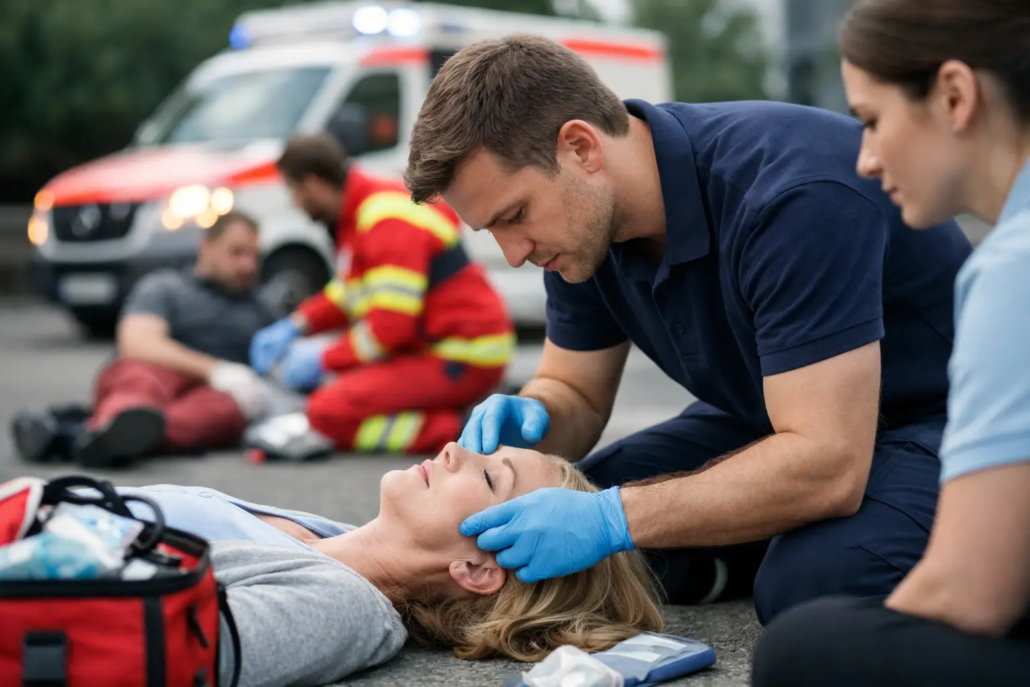
First Aid for Support Workers in Real Emergencies
A client suddenly becomes pale during a community outing. Another slips in the bathroom, or begins coughing while eating. In these moments, first aid for support workers is not about having every answer. It is about recognising what is happening, acting within your training, calling for help early and helping the person feel safe until further care arrives.
Support work is practical, relationship-based work. You may be in a client’s home, an aged care setting, a day program, supported accommodation or out in the community. Emergency support can look different in each setting, but your responsibility remains clear: preserve life, prevent the condition from becoming worse, promote recovery where possible, and follow your workplace procedures.
Why first aid matters in support work
Support workers often spend long periods with clients and may be the first person to notice a change in their health, behaviour or level of responsiveness. This can include an injury after a fall, breathing difficulty, a seizure, symptoms of diabetes, an allergic reaction, a burn, choking or signs of a possible stroke or heart attack.
Many people receiving support have complex health needs, reduced mobility, communication differences or individual care plans. That does not mean every incident will become an emergency. It does mean small changes should be taken seriously, observed carefully and communicated clearly. Knowing first aid gives you a calm, structured starting point when the unexpected happens.
It also helps protect dignity. A competent response is not only about clinical actions. It includes speaking respectfully, seeking consent where the person can give it, maintaining privacy, reassuring family members or other clients, and avoiding unnecessary attention or alarm.
First aid for support workers starts with DRSABCD
Australian first aid training commonly uses the DRSABCD action plan to guide an initial response. It gives you a sequence to follow when pressure makes it hard to think clearly.
D – Danger: Check for anything that could harm you, the person or others nearby. This may be traffic, a wet floor, broken glass, unsafe equipment, smoke or an aggressive bystander. Do not put yourself at risk. A second casualty helps no one.
R – Response: Check whether the person responds. Speak clearly, use their name if known, and follow their communication preferences where possible. A person who is awake may still need urgent help, especially if they have chest pain, facial drooping, severe bleeding or sudden confusion.
S – Send for help: Call Triple Zero (000) when an emergency response is needed. In a workplace, alert the designated first aider, supervisor or team leader as required. If you are not alone, give another person a specific task, such as calling 000, finding the first aid kit or meeting paramedics at the entrance.
A – Airway, B – Breathing, C – CPR, D – Defibrillation: Check the airway and breathing. If the person is unresponsive and not breathing normally, begin CPR if trained and it is safe to do so. Use an automated external defibrillator, or AED, as soon as one is available and follow its voice prompts.
DRSABCD is not a substitute for accredited training or your organisation’s emergency policies. It is a reliable framework that helps you make safe decisions while urgent assistance is arranged.
Know your role, your client and your workplace plan
First aid is one part of safe support practice. Before an incident occurs, take time to understand the information available to you. This may include individual support plans, health care plans, mobility assessments, behaviour support plans, medication information and emergency contacts.
For example, a client with epilepsy may have an agreed seizure management plan. Someone living with diabetes may have specific instructions about recognising and responding to low blood glucose. A person with a known allergy may have an anaphylaxis plan and prescribed medication. Follow the authorised plan and your training rather than relying on assumptions or advice from a bystander.
Your scope of practice matters. Support workers should not diagnose conditions, administer medication without the appropriate authority, or attempt techniques they have not been trained to perform. If you are unsure, seek help. Calling 000 or contacting a supervisor early is a sound professional decision, not a failure of confidence.
There can also be a difference between what is appropriate in a client’s home and what is possible in a facility with clinical staff on site. Your workplace procedures should explain who to notify, where emergency equipment is located, how incidents are documented and how to communicate with families or guardians. Practise finding this information before you need it.
Common situations where a calm response counts
Falls are common in aged care and disability support, but a person who has fallen should not automatically be moved. Check for pain, injury, head strike, changes in consciousness and their ability to move. Keep them comfortable, call for assistance and follow workplace procedures. Moving someone too quickly can worsen an injury, particularly when there may be a fracture, neck injury or hip injury.
Choking requires immediate action. Encourage coughing if the person can cough effectively. If they cannot breathe, speak or cough, use the response taught in your current first aid training and call 000. After a choking episode, the person may still need medical assessment, even if the obstruction appears to clear.
With suspected stroke, time matters. Sudden facial weakness, arm weakness, speech difficulty, severe dizziness or confusion should be treated as urgent. Call 000 and note the time symptoms began, or when the person was last known to be well. Do not give food, drink or medication unless directed by an authorised health professional or emergency service.
A seizure can be confronting for other clients and workers. Focus on protecting the person from injury, timing the seizure, removing nearby hazards and allowing space around them. Do not restrain them or place anything in their mouth. Call 000 if it is a first seizure, it lasts longer than five minutes, repeated seizures occur, they are injured, pregnant, have diabetes, or breathing and recovery are a concern. Always follow the person’s individual seizure plan where one is available.
Infection control is part of first aid
First aid often involves body fluids, close contact and contaminated surfaces. Standard precautions protect both you and the person receiving care. Use gloves when there is a risk of contact with blood or body fluids, wash or sanitise your hands as soon as practical, and dispose of contaminated items according to workplace procedure.
Gloves do not replace hand hygiene, and they should not be used as a reason to touch clean surfaces such as door handles, pens or your mobile. If a sharps injury or exposure occurs, act promptly and report it immediately. Your workplace should have clear procedures for post-exposure support and follow-up.
Communicate, record and reflect after the emergency
The response does not finish when paramedics arrive or the client appears settled. Provide a concise handover: what you observed, when it began, actions taken, relevant health information available and any changes in the person’s condition. Facts are more useful than guesses.
Complete incident documentation as soon as possible while details are clear. Record what happened, who was present, notifications made and the care provided in line with your organisation’s requirements. Avoid judgemental language. Rather than writing that a client was “difficult”, describe what you saw and heard.
Emergencies can affect workers emotionally, particularly when they involve a person you know well. Speak with your supervisor, access workplace support if needed and take part in a debrief. Reflection is not about blame. It helps teams identify what worked, what needs improvement and whether a client’s support plan should be reviewed.
Keep your skills current and practical
First aid skills fade when they are not used. Regular refresher training helps you maintain CPR technique, practise using an AED, respond to changing guidelines and build the confidence to act decisively. It also gives you a safe place to ask questions about scenarios you may encounter in care and community settings.
For people beginning a career in support, nationally recognised first aid and CPR training can strengthen job readiness alongside a qualification in aged care, disability support or community services. For experienced workers, current training demonstrates commitment to safe practice and can support employers’ compliance requirements. Equinox College’s practical training approach is designed to connect these skills with the situations workers may face on shift.
The best first aid response is rarely dramatic. Often, it is a support worker who notices a concern early, stays calm, follows the right steps and makes sure the person is not left to face an emergency alone.
 07 3106 3859
 admin@equinoxsg.com.au
 Shop 14, Level 1-110 Morayfield Rd, Caboolture South, QLD 4510
 PO Box 909, Morayfield QLD 4506

Leave a Reply
Want to join the discussion?Feel free to contribute!